



Best Binoculars for Bird Watching: How to Choose a First Pair
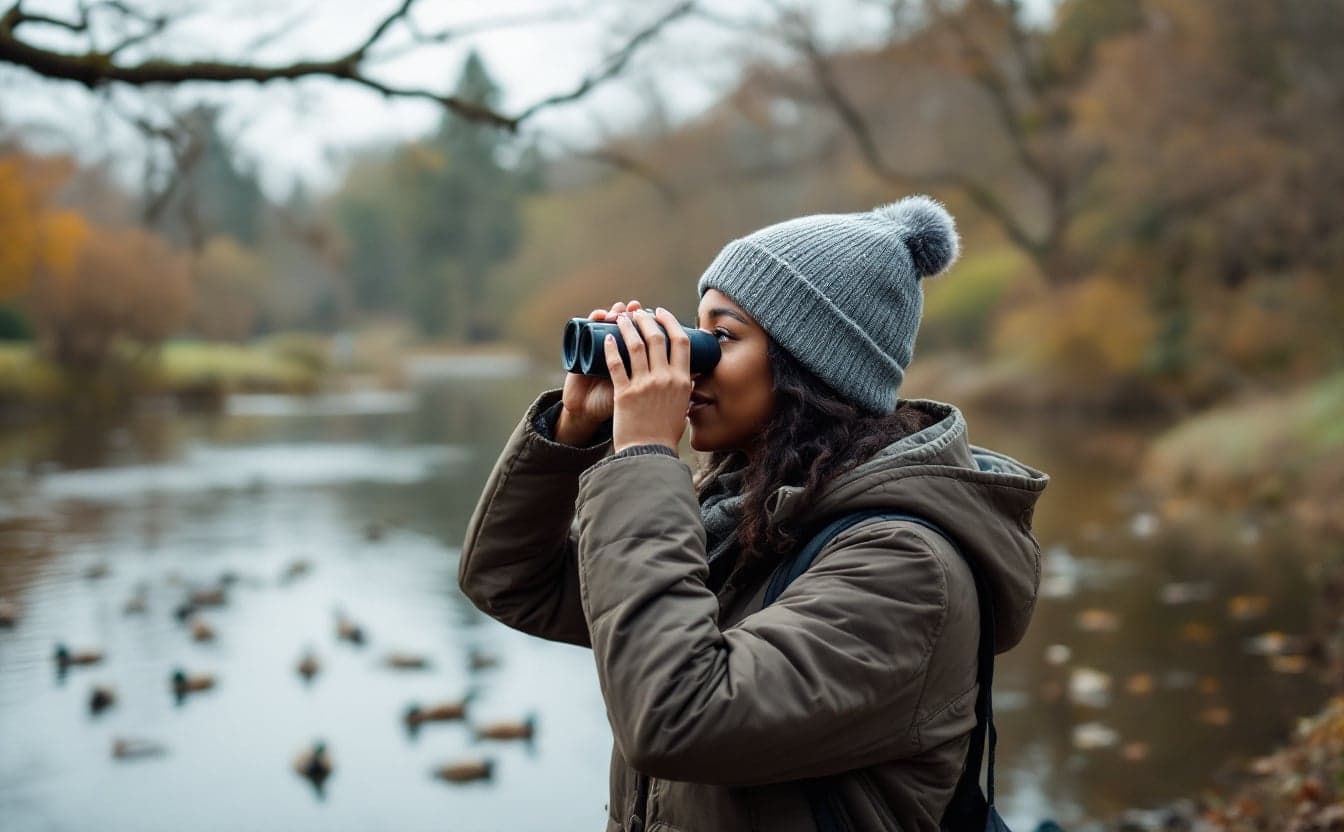
Ask a room of experienced birders what a beginner should buy and most of them will answer with a number before they name a brand: 8x42. It is not a secret handshake. It describes a tool that is easy to hold steady, bright enough for a gray morning under trees, and wide enough to find a warbler before it hops to the next branch.
Gear links may earn us a commission. As an Amazon Associate I earn from qualifying purchases.
Trail-ready picks
 Any weatherCelestron Nature DX 8x42A widely recommended first pair: waterproof, with a close focus for birds at the feeder.$148.97 Amazon price, as of Oct 22, 2026, 4:26 PM UTCSee on Amazon
 Any weatherSibley field guide, eastern North AmericaPainted plates of every regular eastern species, with the field marks pointed out.$13.29 Amazon price, as of Oct 22, 2026, 4:26 PM UTCSee on Amazon
 Any weatherSKYSPER 20-liter daypackA light, packable 20-liter bag with bottle pockets; plenty for a day on the trail.$43.99 Amazon price, as of Oct 22, 2026, 4:26 PM UTCSee on Amazon
Product prices and availability are accurate as of the date/time indicated and are subject to change.
So here is the short answer. For most people starting out, the best binoculars for bird watching are a waterproof 8x42 roof-prism pair that focuses down to about 6 feet, gives at least 15 millimeters of eye relief if you wear glasses, and still feels comfortable around your neck after two hours. You do not need to spend much to get there. You may not need to buy anything for your first season, because well over a hundred libraries and many bird clubs lend binoculars for free.
The rest of this guide explains the numbers so you can judge any pair on a store shelf, then walks through three pairs that make sense as a first purchase or a later step up.
Three pairs worth a look
| Pair | Best for | Glass and build | Maker's warranty |
|---|---|---|---|
| Celestron Nature DX 8x42 | A first pair | Fully multi-coated lenses, phase-coated BaK-4 prisms, waterproof and fogproof | Limited lifetime |
| Athlon Midas UHD 8x42 | Stepping up for cleaner color | ED glass, waterproof | Lifetime, transferable |
| Vortex Diamondback HD 8x42 | Stepping up, hard use, shared family pair | HD glass, dielectric prism coatings, waterproof and fogproof | Unconditional lifetime |
All three are 8x42s on purpose. If you already suspect you want something different, the next section explains when that makes sense.
What 8x42, 10x42 and 8x32 actually mean
The first number is magnification. At 8 power, a robin 100 feet away looks the way it would at about 12 feet. The second number is the diameter of each front lens in millimeters. Bigger lenses gather more light, and they also add weight.
Divide the second number by the first and you get the exit pupil, the width of the beam of light that reaches your eye. An 8x42 gives 5.25 mm, a 10x42 gives 4.2 mm and an 8x32 gives 4 mm. At noon your own pupils shrink so much that all three look equally bright. The difference shows up at dawn, at dusk and in deep shade, which happens to be when many birds are most active.
8x42: the default for good reason
Eight power magnifies the small shake in everyone's hands less than ten power does, so the image sits still long enough to see an eye ring or a wing bar. The view is wider, which makes it easier to find a small bird moving through leaves. Full-size 8x42s tend to weigh somewhere around a pound and a half; the two pairs here with published weights come in near 22 ounces.
10x42: more reach, more wobble
Ten power earns its keep in open country: shorebirds on a mudflat, ducks across a reservoir, a hawk on a distant pole. The trade is a narrower view and a shakier image. If your hands tremble, if you are new and still learning to find birds quickly, or if most of your birding happens in a wooded park, start with 8.
8x32: the lighter option
An 8x32 is smaller and often several ounces lighter than an 8x42, and many have a generous field of view. It is a good fit for travel, for teenagers and smaller hands, and for anyone whose neck or shoulders make weight the deciding factor. You give up a little brightness in the last half hour of light.
Before you go
 Adventure Medical Kits Ultralight/Watertight .5$31.95 Amazon price, as of Oct 22, 2026, 4:27 PM UTCSee on Amazon
 TrailBuddy aluminum trekking poles$39.91 Amazon price, as of Oct 22, 2026, 4:26 PM UTCSee on Amazon
 Columbia Watertight II rain jacket (men's)$70.00 Amazon price, as of Oct 22, 2026, 4:26 PM UTCSee on Amazon
Product prices and availability are accurate as of the date/time indicated and are subject to change.
Gear links may earn us a commission. As an Amazon Associate I earn from qualifying purchases.
Three specs that matter more than people expect
Field of view
Makers list it as feet at 1,000 yards or as degrees (one degree is about 52 feet at 1,000 yards). Many 8x42s land somewhere between 330 and 430 feet. Wider is friendlier for beginners, because the bird is more likely to be in the circle when you raise the binoculars. Celestron lists 388 feet for the Nature DX and Vortex lists 393 for the Diamondback HD.
Close focus
This is the nearest distance at which the binoculars can focus. Six feet or less is handy for birds at a feeder, a sparrow in the hedge beside a path, and butterflies and dragonflies in summer. The Diamondback HD focuses to 5 feet and the Nature DX to 6.5, according to their makers.
Eye relief, if you wear glasses
Eye relief is how far behind the eyepiece your eye can sit and still see the whole image. Glasses hold your eye farther back, so wearers need more of it: look for about 15 mm or more, plus eyecups that twist all the way down. Glasses on, eyecups down. Glasses off, eyecups up. If you see a dark ring around the view, the eye relief is too short for you. Both the Nature DX (17.5 mm) and the Diamondback HD (17 mm) leave room for most frames.
One more fit check: fold the two barrels together as far as they go. People with narrow-set eyes, including many kids, sometimes find a pair cannot close enough to give one clean circle.
Glass, coatings and weatherproofing
ED stands for extra-low dispersion glass. It reduces the purple or green fringe you see along the edge of a dark bird against a bright sky, the classic case being a crow on a bare branch at midday. A first pair does not need ED glass, but once you notice fringing it is hard to stop noticing it.
Coatings matter as much as the glass. "Fully multi-coated" means every lens surface that meets air has several layers of coating, which cuts glare and lets more light through. On roof-prism binoculars, phase coatings sharpen contrast and dielectric (mirror-like) prism coatings brighten the image.
Waterproof binoculars are sealed with O-rings and filled with dry nitrogen or argon, so they will not fog inside when you step from a warm car into a cold morning. Birding happens in drizzle and dew, so treat waterproofing as a requirement. All three pairs in this guide are waterproof.
Roof-prism binoculars are the straight-barreled kind. Porro-prism binoculars have the older zigzag shape; they can give a good image for the money, but they are bulkier and fewer of them are sealed against water.
Weight, straps and harnesses
Twenty-two ounces does not sound like much until it has hung from a thin strap for an hour. The fix costs little. Shorten the strap so the binoculars rest high on your chest instead of swinging at your belt. Or switch to a harness, a set of elastic straps that crosses your back and spreads the weight across both shoulders. Harnesses help anyone with neck or back pain, and they keep the binoculars from swinging when you bend over, push a wheelchair or use trekking poles.
Keep the rain guard over the eyepieces on wet days and the lens caps on in the car. To clean the glass, blow off grit first, then wipe gently with a lens cloth. Wiping sand across a lens is how coatings get scratched.
Borrow a pair before you buy
Lending programs have spread fast. When Audubon magazine looked in 2023, it found more than 100 binocular lending programs at libraries in the United States and Canada. The Free Library of Philadelphia began lending birding backpacks in 2017. In New York, the state's I BIRD NY lending program stocks free backpacks with binoculars and field guides at more than 100 public libraries. Many Audubon chapters, nature centers and park programs also hand out loaner binoculars on guided walks; ask when you sign up.
At the library desk, ask for a "birding backpack" or "binocular kit." A week with a borrowed pair tells you whether 8 or 10 power suits you, whether the weight bothers you and whether your glasses work with the eyecups. Our story on gear libraries covers the broader world of lending closets, from tents to snowshoes.
The three pairs in detail
A word on how we chose: these come from makers' published specifications, professional reviews and what long-time owners report about living with them. We have not run our own side-by-side trials.
First pair: Celestron Nature DX 8x42
The Celestron Nature DX 8x42 turns up again and again as a recommended first pair, and the spec sheet explains why. Celestron lists a close focus of 6.5 feet, 17.5 mm of eye relief, a 388-foot field of view and phase-coated BaK-4 prisms in a waterproof, fogproof, nitrogen-purged body. That covers every item on the checklist above. What you do not get is ED glass, so expect some color fringing on backlit birds. For learning field marks at a feeder, along a creek or in a city park, it does the job.
Step up for color: Athlon Midas UHD 8x42
The Athlon Midas UHD 8x42 adds ED glass, which shows up as cleaner edges on feathers and truer color in mixed light, the moment a dull brown bird in the shade turns out to have a rusty cap. Athlon's lifetime warranty is transferable, which matters if the pair is ever handed down. It suits someone who is out every week and has started to care about the difference between a good view and a great one.
Step up for hard use: Vortex Diamondback HD 8x42
The Vortex Diamondback HD 8x42 pairs an HD glass system and dielectric prism coatings with the specs that make daily birding easier: 5-foot close focus, 17 mm of eye relief and a 393-foot field of view, at 21.8 ounces by Vortex's count. The bigger selling point is the company's unconditional lifetime warranty, which covers damage regardless of fault. For a family that shares one pair, or a pair that rides in a kayak, that promise is worth a lot.
A field guide and two free apps
Binoculars show you the bird. Something has to help you name it.
Merlin, the free app from the Cornell Lab of Ornithology, can identify birds three ways: by listening (Sound ID suggests species as birds sing), from a photo, or by asking a few questions about size, color, place and date. Download your region's bird pack and it works without a cell signal. eBird, also free from Cornell, is where birders keep lists of what they saw. Before you go anywhere new, its hotspot pages show what others reported there in the past week.
A paper guide still earns a spot in the bag. It needs no battery, and it puts similar species side by side so you learn what separates them. David Sibley's guides are painted, with the key field marks pointed out on each bird.
Pack list
- Celestron Nature DX 8x42 about 1.4 lbA widely recommended first pair: waterproof, with a close focus for birds at the feeder.$148.97 Amazon price, as of Oct 22, 2026, 4:26 PM UTCSee on Amazon
- Sibley field guide, eastern North AmericaPainted plates of every regular eastern species, with the field marks pointed out.$13.29 Amazon price, as of Oct 22, 2026, 4:26 PM UTCSee on Amazon
Product prices and availability are accurate as of the date/time indicated and are subject to change.
The eastern guide covers the regular species of eastern North America. The western companion covers the West. If you live near the dividing line on the Great Plains or along the Rockies, page through both at the library before you choose.
How to hold and focus binoculars
Most frustration with new binoculars comes from skipping the two-minute setup. Do it once at home and write the diopter setting on a piece of tape.
- Fold the barrels until you see one round circle, not two overlapping ones.
- Set the eyecups: down for glasses, up without them.
- Pick a sign or a branch about 30 feet away. Close your right eye and turn the center wheel until the left side is sharp.
- Now close your left eye and turn the diopter ring, usually on the right eyepiece, until the right side is sharp. Leave it there. From now on you focus with the center wheel only.
- Hold the binoculars with your elbows tucked against your chest and your thumbs underneath. Lean on a tree, a post or a railing when you can. Sitting steadies the view even more.
Then the trick that makes everything easier: when a bird moves, keep your eyes on it and bring the binoculars up to your eyes without looking down. Most beginners look at the binoculars, then search the sky. Practice on pigeons on a wire or ducks on a pond, which hold still long enough to get the motion into your muscles.
Where to point them first
Close to home is fine. Late October brings migrant ducks to city ponds, sparrows to weedy park edges and the first winter regulars to feeders, all of them visible from a bench or a paved path. Not every neighborhood has a pond or a patch of woods within walking distance, a gap our story on park access by ZIP code maps in detail, so a cemetery, a schoolyard edge or a riverside path counts too. If you are heading farther out for a full morning, our list of what to pack for a day hike covers water, layers and the rest.
Give yourself one assignment for the first trip: pick a common bird you can already name and look at it until you can describe three things about it that you never noticed before. That habit, more than any pair of binoculars, is what turns a walk into birding.
Next: try the Hiking Time Calculator or browse the full Pack list.