
Green Gentrification: How to Build Parks Without Pricing Out Neighbors
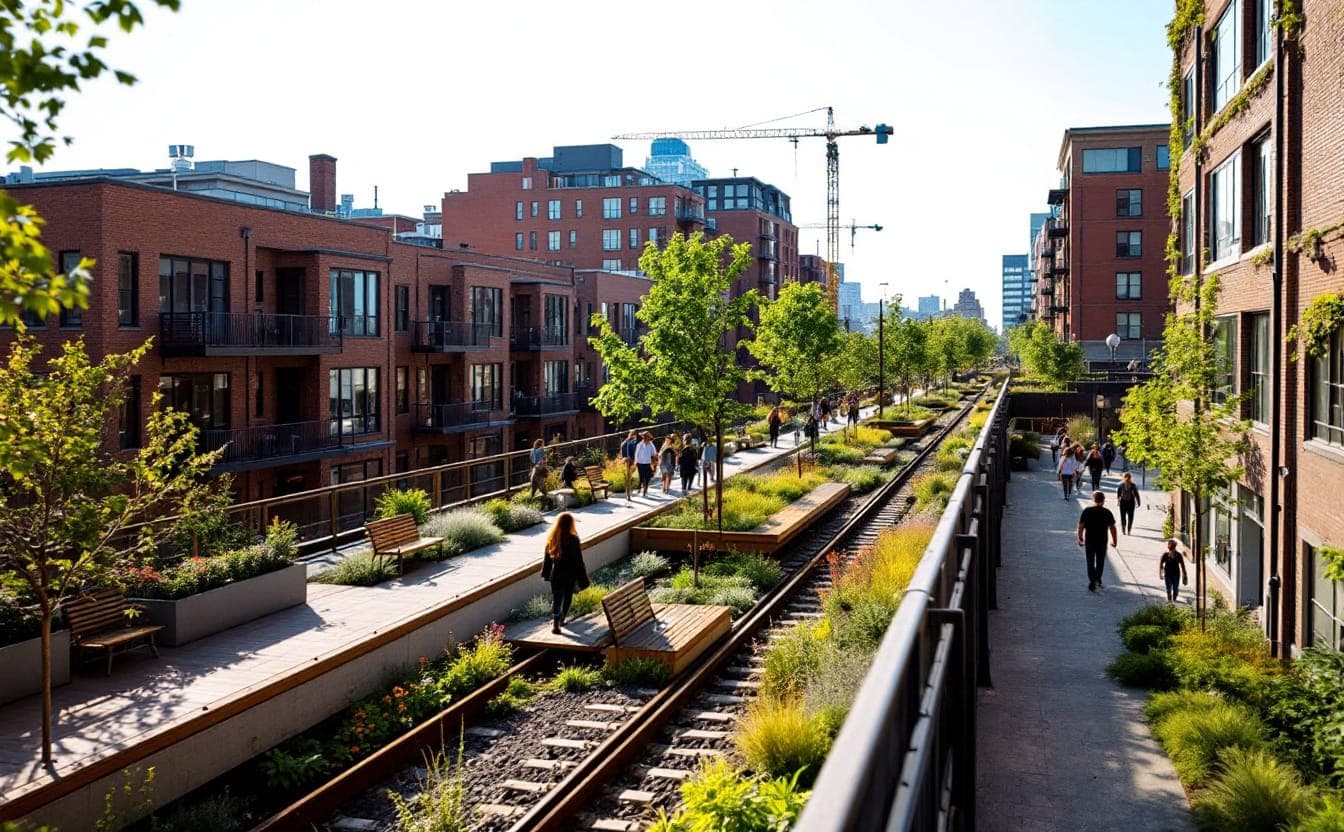
The last freight train ran on Manhattan's elevated West Side line in 1980. For nearly two decades the tracks sat rusting above the streets of Chelsea, until two neighborhood residents formed Friends of the High Line in 1999 to save the structure from demolition. The first section of the park opened in 2009. It became one of the most visited public spaces in New York and one of the most copied park projects in the world.
It also became a case study in something planners now call green gentrification: the pattern in which a new park, greenway or environmental cleanup raises land values and rents enough to push out the people who lived nearby before the improvement arrived. The sociologists Kenneth Gould and Tammy Lewis wrote a book with that title in 2017, built around neighborhoods in Brooklyn, and researchers such as Isabelle Anguelovski have tracked the same dynamic across many cities in North America and Europe.
The uncomfortable part is that these are often the very amenities environmental justice advocates fought for. Neighborhoods that spent decades next to rail yards, polluted creeks and vacant lots deserve trees and clean water. The question is how to deliver them so the residents who endured the bad years are still around to enjoy the good ones.
Three projects, three lessons
The High Line: success that outran its neighbors
The High Line's surroundings changed fast. A 2005 rezoning of West Chelsea encouraged dense new development along the corridor, and luxury towers followed the park. Two large public housing developments sit a short walk away, the Chelsea-Elliott Houses and the Fulton Houses, and many residents there said for years that the park did not feel like it was meant for them.
Robert Hammond, one of the co-founders, later said publicly that the team had not done enough to involve nearby public housing residents from the beginning. The organization went on to start the High Line Network, which connects similar infrastructure-reuse projects in other cities so they can plan for equity earlier than the High Line did. That is a rare and useful thing: a celebrated project naming its own shortfall and turning it into advice for others.
The Atlanta BeltLine: promises that lagged the trail
The BeltLine began as a 1999 master's thesis by Ryan Gravel, then a Georgia Tech student, proposing transit and trails along a loop of old railroad corridors circling central Atlanta. The idea grew into a 22-mile project. When the city created a tax allocation district to help fund it in 2005, it set a goal of 5,600 affordable housing units along the corridor by 2030.
The Eastside Trail opened in 2012 and was an immediate hit. Housing affordability did not keep pace. A 2017 investigation by the Atlanta Journal-Constitution found the project far behind its affordable housing goal. Gravel himself stepped down from the board of the BeltLine's fundraising partnership in 2016, saying the project was drifting from its equity commitments. Researchers Dan Immergluck and Tharunya Balan later found that home values near the trail rose substantially faster than those of comparable homes farther away, and that the jump came early, around the time construction got underway rather than years after.
That timing is the BeltLine's sharpest lesson. Speculation starts with the announcement, not the ribbon-cutting. Any protection that arrives after the trail opens is already late.
The 11th Street Bridge Park: equity planning before the first pour
In Washington, DC, the old 11th Street Bridge across the Anacostia River left behind a set of concrete piers. A project led by Building Bridges Across the River proposed turning them into an elevated park linking the fast-changing Navy Yard and Capitol Hill side of the river with Anacostia and the neighborhoods of Wards 7 and 8, which are mostly Black and have far lower average incomes.
The team had watched what happened in Chelsea and Atlanta. Before construction, it worked with residents to publish an Equitable Development Plan in 2015 and later updated it. The plan covers workforce training tied to construction and park jobs, support for small businesses, tenant rights education and home-buyer clubs, cultural programming that centers the history of the east-of-the-river communities, and housing. One concrete result is the Douglass Community Land Trust, created to hold land permanently affordable in the area around the park.
It is too early to say how well the plan will hold up once the park is busy. But the sequence is right: commitments, staff and money for anti-displacement work came first, and they were written down where anyone can check them.
The toolkit, and what each tool protects
No single tool covers everyone. Renters, longtime homeowners, small businesses and workers face different risks, and the tools that help one group may do little for another. The table below sorts the main options by who they protect and where they tend to fall short. Our collection of initiative models includes several community conservation and regional collaborative examples that pair green investment with these kinds of protections.
| Tool | What it protects | Where it falls short |
|---|---|---|
| Community land trust | Permanent affordability of homes on land the trust owns; a path to ownership for lower-income buyers | Needs land early, before prices rise; scale depends on public or philanthropic capital |
| Equitable development or anti-displacement plan | Public, measurable commitments made before construction | Only as strong as its funding, staffing and willingness to report bad news |
| Tenant protections (right to counsel, notice rules, tenant opportunity to purchase) | Renters' ability to stay in place and to bargain when buildings sell | Rent regulation is preempted by state law in many states; enforcement takes legal aid capacity |
| Dedicated affordable housing funding (for example, a share of tax increment) | New and preserved below-market units near the amenity | Targets can slip, as Atlanta's experience shows, without annual public accounting |
| Property tax relief for longtime owners (deferrals, circuit breakers, homestead caps) | Older and fixed-income homeowners facing rising assessments | Does little for renters; can be costly for local budgets |
| Local hiring and first-source agreements | Construction and operations jobs for nearby residents | Needs training pipelines that start early and someone tracking the numbers |
| Small business and commercial lease support | Corner stores, barbers and other neighborhood businesses | Commercial tenants usually have far fewer legal protections than residential ones |
| "Just green enough" design scope | Health and environmental benefits without a luxury-amenity premium | Can be misread as settling for less unless residents define what "enough" means |
A note on "just green enough"
The last row comes from geographers Winifred Curran and Trina Hamilton, who introduced the phrase "just green enough" in a 2012 paper about Greenpoint, Brooklyn, near the heavily polluted Newtown Creek. Residents and local workers there pushed for real cleanup of contamination while resisting the kind of flagship waterfront design that would mainly attract new investment and push out industrial jobs. Curran and Hamilton later edited a 2018 book of the same name collecting examples from other places.
The idea is easy to caricature as "keep poor neighborhoods a little bit ugly." That is not the argument. The point is that the people who live there should decide which environmental improvements serve them (a cleaned-up lot, safe drinking water, shade on the walk to school) and which mostly serve a real estate market. Sometimes a neighborhood wants the big signature park. Sometimes it wants a dozen pocket parks and a remediated creek with no espresso kiosk in sight.
Before you go
 Downspout diverter for 2x3 and 3x4 inch spouts$24.99 Amazon price, as of Oct 22, 2026, 4:26 PM UTCSee on Amazon
 FosPower A1 emergency weather radio$29.99 Amazon price, as of Oct 22, 2026, 4:26 PM UTCSee on Amazon
 Jackery Explorer 300 (about 290 Wh)$259.00 Amazon price, as of Oct 22, 2026, 4:26 PM UTCSee on Amazon
Product prices and availability are accurate as of the date/time indicated and are subject to change.
Gear links may earn us a commission. As an Amazon Associate I earn from qualifying purchases.
Order of operations
If you work for a park agency, a land trust or a nonprofit advocating for a new greenway, the cases above point to a sequence more than a menu.
Secure land first. Once a project is public, nearby parcels get more expensive. Community land trusts and affordable housing developers need to acquire sites while prices still reflect the old neighborhood. National networks such as Grounded Solutions Network support land trusts and other shared-equity housing models and can help groups get started.
Write the plan before the design. An equitable development plan written alongside residents, with targets and dates, gives everyone something to hold the project to. Publish it.
Budget for staff. Tenant organizers, legal aid attorneys and workforce coordinators cost money every year. A plan without staff is a press release.
Measure displacement directly. Track rents, eviction filings, school enrollment, business turnover and who uses the park. Share the data annually, especially when it looks bad. The landmark reports we explain show how much a well-documented baseline matters later.
Keep decision-making with long-term residents. Advisory boards are a start. Real authority over programming, naming, concessions and design changes is better.
What park advocates can do this year
Most people reading this are not running a 22-mile megaproject. You might be on the board of a friends-of-the-park group, working at a watershed nonprofit pushing for a creek restoration, or staffing a city parks department with a modest capital budget. The same principles scale down.
Ask the housing question at the first community meeting, not the last. Invite the local tenants' association and legal aid office into the coalition before the grant application is due. Build anti-displacement work into the budget line, even if it's small. When the park opens, look at who is in it, and at who isn't.
Above all, treat displacement as an environmental outcome. If a cleaner river or a new tree canopy ends up benefiting a different set of people than the ones who lived with the pollution, the project has relocated environmental benefits rather than delivered environmental justice.
For further reading, including Gould and Lewis's book and the Curran and Hamilton volume, see our annotated resource list. The High Line's own site also documents how the organization has tried to change its approach since opening.
Gear links may earn us a commission. As an Amazon Associate I earn from qualifying purchases.
Pack list for home and block
- Downspout diverter for 2x3 and 3x4 inch spoutsFills the barrel from the downspout, then sends water back down the spout once it is full.$24.99 Amazon price, as of Oct 22, 2026, 4:26 PM UTCSee on Amazon
- FosPower A1 emergency weather radio about 11 ozNOAA weather alerts, a hand crank and solar panel, and a USB port to top up a phone.$29.99 Amazon price, as of Oct 22, 2026, 4:26 PM UTCSee on Amazon
- Jackery Explorer 300 (about 290 Wh) 7.1 lbSmall enough to carry; keeps phones, a laptop, lights and a small fan going for an evening.$259.00 Amazon price, as of Oct 22, 2026, 4:26 PM UTCSee on Amazon
- BLUETTI power stationsBLUETTI's own store, with home backup bundles and solar panels.Shop at BLUETTI
Product prices and availability are accurate as of the date/time indicated and are subject to change.
Next: try the Rain Barrel Calculator or browse the full Pack list.