



Community Solar for Renters: How It Works and What to Check Before You Sign
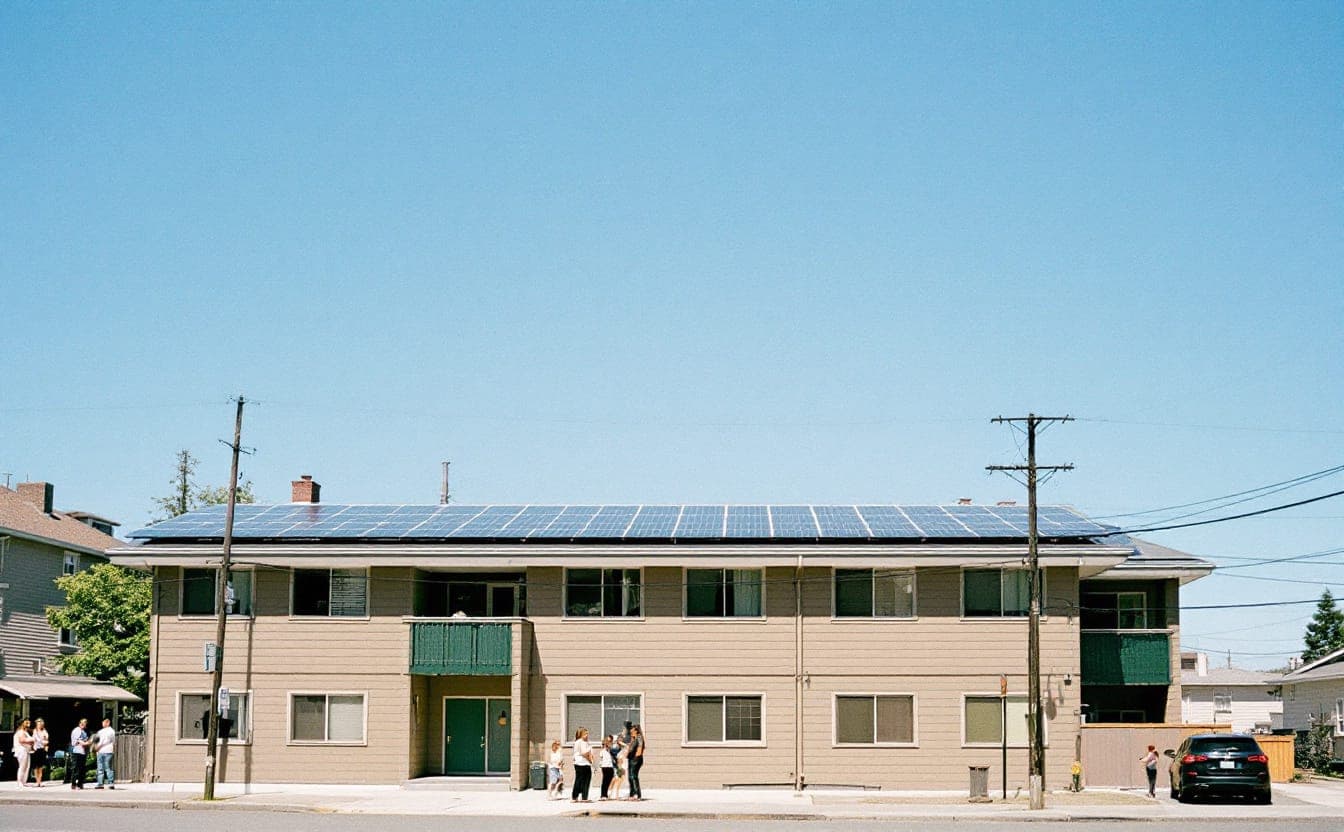
The solar panels that lower your electric bill don't have to be on your roof. They might sit on a warehouse across the county, a closed landfill at the edge of town or a church roof a few blocks away. That is the basic idea of community solar, and it is one of the few ways renters, condo owners and people with shady roofs can get a share of solar power without installing anything.
It also comes with contracts, sales pitches and billing arrangements that can be confusing, and the quality of offers varies widely. This guide covers how subscriptions work, how to read an offer, which red flags to watch for, and how neighborhood groups can go further by organizing subscribers or hosting a project themselves. A short glossary at the end defines the terms you'll see in contracts.
How the money moves
A community solar project is a mid-sized solar array connected to the local grid. Instead of one owner using all the power, the output is divided among subscribers, usually households and businesses served by the same utility.
When the array produces electricity, it flows into the grid like any other power plant's output. The utility tracks your share and applies a bill credit to your account, usually measured in dollars, based on the kilowatt-hours your portion produced and the credit rate set by your state's rules. You pay the project's subscription company for that share. If the subscription costs less than the credits you receive, you save money.
A simple hypothetical: your share produces $60 worth of credits on this month's utility bill, and your subscription charge is $54. You're $6 ahead. Offers are commonly framed this way, as a percentage discount on the value of your credits, and a discount in the neighborhood of 10 percent is a typical pitch in many markets. Your actual savings depend on production (lower in winter), your usage, and how credits are calculated where you live.
There are two common payment models.
Pay-as-you-go subscriptions charge you monthly for the credits you receive, usually at a discount. There's no upfront cost. This is the model most renters encounter.
Ownership or prepaid models ask you to buy panels or a share of the array upfront, in exchange for credits over many years. These can pay off over time but tie up money and are harder to exit, which makes them a poor fit for most renters who expect to move.
Billing comes in two styles. With separate billing, you get your normal utility bill showing the credit plus a second bill from the subscription company. With consolidated billing (called net crediting in some states), the utility subtracts the subscription fee and shows only your net savings on one bill. Consolidated billing is simpler and harder to get wrong, so it's worth preferring where it's offered.
Is it available where you live?
Community solar depends on state policy. A state has to allow multiple customers to receive credits from a single off-site array, and its utility regulators have to set the rules for how credits are valued. Programs open to residential subscribers exist in a number of states, including well-established markets such as Minnesota, Colorado, Massachusetts, New York, Maryland, New Jersey, Illinois and Maine. Many other states have no program or only small pilots.
Some utilities also run their own "shared solar" or green power options. Read these carefully: some cost more than standard service rather than less, because you're paying a premium to support renewable energy rather than receiving discounted credits.
To check what's available, start with your state energy office or public utility commission. The Solar Energy Industries Association tracks state solar policy at a national level, and many state agencies keep lists of registered community solar providers.
A note on 2025 and after
Federal support for solar changed considerably in 2025. Tax credits and grant programs that had helped finance many projects, including some aimed specifically at low-income households, were scaled back or ended. State programs are now doing more of the work, and some projects in the pipeline have been delayed, restructured or cancelled. If an offer is for a project that hasn't been built yet, ask when it's expected to start producing and what happens to your subscription if it never does.
Before you go
 RTS 50-gallon rain barrel with brass spigot$99.00 Amazon price, as of Oct 22, 2026, 4:26 PM UTCSee on Amazon
 Downspout diverter for 2x3 and 3x4 inch spouts$24.99 Amazon price, as of Oct 22, 2026, 4:26 PM UTCSee on Amazon
 FosPower A1 emergency weather radio$29.99 Amazon price, as of Oct 22, 2026, 4:26 PM UTCSee on Amazon
Product prices and availability are accurate as of the date/time indicated and are subject to change.
Gear links may earn us a commission. As an Amazon Associate I earn from qualifying purchases.
What you're actually buying
Subscribing to community solar gets you bill credits. Whether it also lets you say you "use solar power" depends on who keeps the project's renewable energy certificates (RECs), the tradable records that represent the environmental attributes of each unit of clean power. In many projects the developer sells the RECs separately to help pay for the array. That's legal and common, and it doesn't affect your savings, but it means the claim to the solar power belongs to whoever bought the RECs. If the clean-energy claim matters to you or your organization, ask.
Red flags in the contract
Most community solar offers are legitimate. The problems usually come from terms that look harmless at the kitchen table and hurt years later. Read for these before signing.
Escalators. Some contracts charge a fixed price per kilowatt-hour that rises a set percentage every year. If utility rates rise more slowly than the escalator, your savings shrink and can disappear entirely. A discount tied to the value of your credits protects you better than a fixed rate that escalates.
Cancellation and early termination fees. Look for what it costs to leave, and whether fees are waived if you move out of the utility's service area. Renters should favor contracts that can be cancelled with short notice and no fee, or that let you transfer the subscription to a new address within the same utility territory.
Credit checks. Many residential programs, especially those designed for low-income households, don't require them. If a provider runs a hard credit inquiry, that can affect your credit score; ask before you sign.
Long terms. Contracts of 20 years or more exist. For a renter, month-to-month or short-term subscriptions are far safer.
Oversizing. A subscription sized larger than your actual electricity use can leave you with excess credits. Find out what happens to those: do they roll over, get paid out, or expire?
No savings floor. Some contracts promise savings in the sales pitch but not in writing. Look for a guaranteed minimum discount.
Pressure at the door. Be careful with door-to-door or phone sales that ask for your utility account number and a signature on the spot. Take the paperwork, check that the company is registered with your state program if registration is required, and decide later.
Auto-renewal and data sharing. Note whether the contract renews automatically and what usage data you're authorizing the company to receive from your utility.
Low-income carve-outs
Several states have written equity requirements into their programs, though the details vary a great deal. Common features include setting aside a share of each project's capacity for low-income subscribers, requiring a minimum guaranteed discount for those households, dropping credit checks, and letting people qualify automatically if they're already enrolled in programs such as SNAP or energy bill assistance. Illinois, for example, runs a state program called Illinois Solar for All for income-eligible residents.
If you qualify for a carve-out, your offer should be noticeably better than the standard one: no fees to join or leave, a guaranteed discount and a simple bill. If it isn't, ask why. Community organizations that already help residents apply for energy assistance are often the best partners for spreading the word, because they're trusted and they know the paperwork.
For neighborhood groups: two ways in
Organize subscribers
The lighter-lift option is to help neighbors sign up for good offers. A tenants' association, faith community or block club can compare the providers serving its area, hold contract-reading nights with someone who understands the terms, and in some cases negotiate group terms in exchange for bringing in a batch of subscribers. Translation and in-person help matter. An offer that looks clear in English on a laptop may not be clear to a grandparent reading it on a phone.
Host or co-own a project
The bigger step is helping a project get built on a local site. A few practical points from the way these projects tend to unfold:
Start with the site. Large flat roofs on schools, churches, warehouses and community centers work well, as do parking-lot canopies and closed landfills. A roof should have many years of life left, since panels typically stay up for decades. Re-roofing first is often cheaper than removing panels later.
Expect the grid to set the pace. Every project has to go through the utility's interconnection process, which can involve studies, upgrades and long waits.
Choose a structure. Some groups lease a roof to a developer and collect rent while negotiating benefits for local subscribers. Others form or partner with a cooperative or nonprofit that owns the array. Ownership brings more control and more risk.
Line up subscribers early. Many projects pair an anchor subscriber, such as a school district or local government, with residential subscribers, which can make financing easier.
Plan for years, not months. Even a smooth project can take a long time from first meeting to first credit.
Conferences are one of the best places to meet developers, lawyers and other groups who have done this already; our guide to gatherings on equity in environmental work covers how to make the most of them. For examples of community-led models in other fields, see our initiatives collection, and for background reading on energy and equity, our annotated resource list.
Glossary
Anchor subscriber: A large customer, such as a city, school district or business, that subscribes to a big share of a project and helps make it financeable.
Bill credit: The dollar amount your utility applies to your bill for your share of the project's output.
Consolidated billing / net crediting: The utility collects the subscription fee and shows only your net savings on one bill.
Early termination fee: A charge for cancelling a subscription before the contract ends.
Escalator: A clause that raises your subscription price by a fixed percentage each year.
Interconnection: The utility's process for approving and connecting a new generator to the grid.
Kilowatt-hour (kWh): The unit of electricity on your bill; one kilowatt of power used for one hour.
Low-income carve-out: A rule reserving part of a program's capacity, or special terms, for income-qualified households.
Renewable energy certificate (REC): A tradable record representing the environmental attributes of one megawatt-hour of renewable electricity.
Subscription: Your agreement to receive credits from a share of a community solar project.
Virtual net metering: A billing arrangement that lets credits from an off-site array apply to your utility account.
Gear links may earn us a commission. As an Amazon Associate I earn from qualifying purchases.
Pack list for home and block
- Jackery Explorer 300 (about 290 Wh) 7.1 lbSmall enough to carry; keeps phones, a laptop, lights and a small fan going for an evening.$259.00 Amazon price, as of Oct 22, 2026, 4:26 PM UTCSee on Amazon
- VIVOSUN dual-chamber compost tumbler 43 galTwo chambers: one batch finishes while you fill the other, and a few turns mix the pile.$67.99 Amazon price, as of Oct 22, 2026, 4:26 PM UTCSee on Amazon
- RTS 50-gallon rain barrel with brass spigot 50 galA sealed 50-gallon barrel with a brass spigot that takes a standard garden hose.$99.00 Amazon price, as of Oct 22, 2026, 4:26 PM UTCSee on Amazon
- BLUETTI power stationsBLUETTI's own store, with home backup bundles and solar panels.Shop at BLUETTI
Product prices and availability are accurate as of the date/time indicated and are subject to change.
Next: try the Rain Barrel Calculator or browse the full Pack list.