
Best Trekking Poles for Knees, Balance and Long Descents
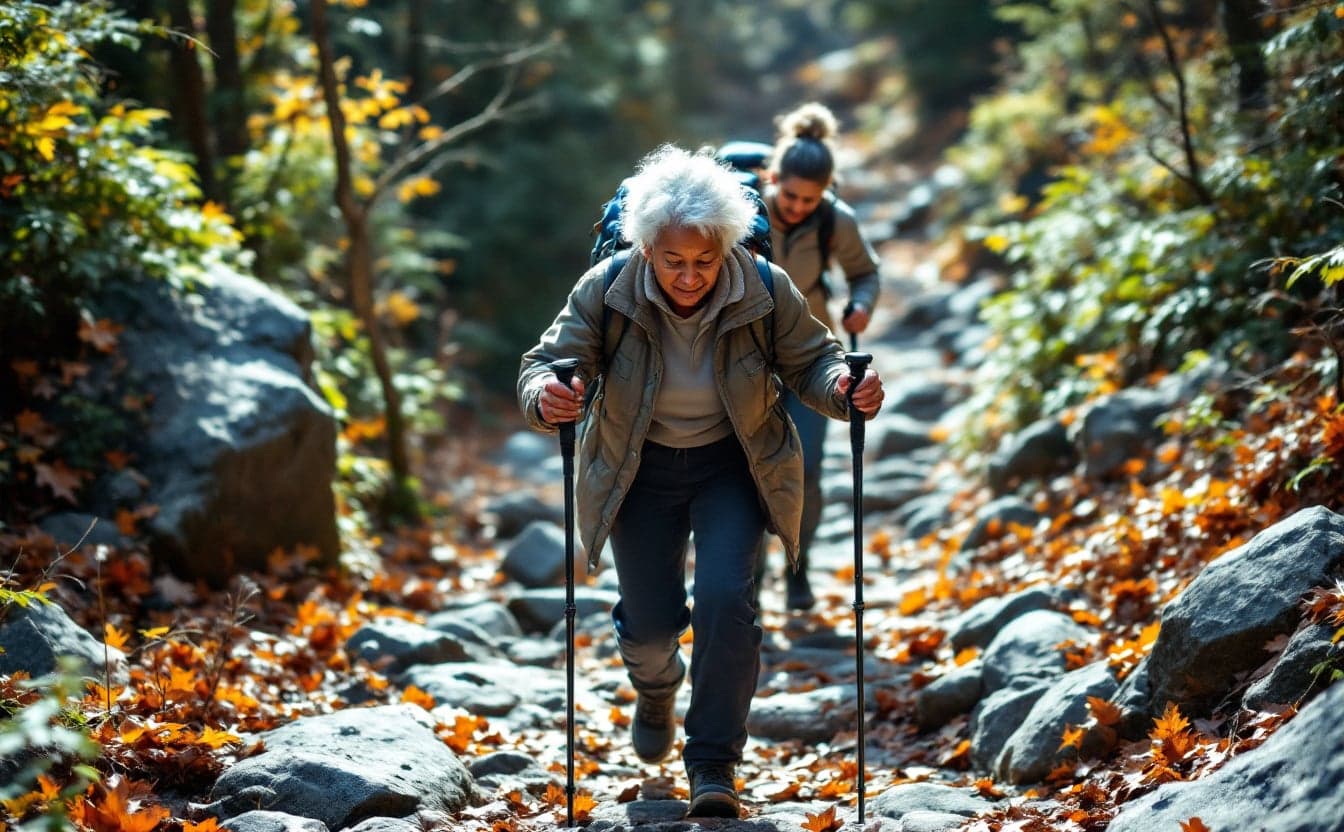
The hardest part of most day hikes is the part nobody trains for: the way down. Climbing tires your lungs, but descending is where knees ache, thighs burn the next morning and most slips happen. That's the job trekking poles do best, and it's why so many hikers who swore they didn't need them now won't leave the trailhead without a pair.
This guide covers what poles actually change, how to size and use them, what separates a good pair from an annoying one, and three pairs worth a look. If you already know what you want, the quick picks are just below.
Quick picks
| Pair | Shaft | Weight (approx.) | Best for |
|---|---|---|---|
| TrailBuddy aluminum | Aluminum, lever locks | 1.2 lb for the pair | A first pair, family sharing, hikers who lean on poles for balance |
| Cascade Mountain Tech aluminum with cork | Aluminum, cork grips | 10 oz per pole | Hot or sweaty hands, long days, durable all-rounder |
| Foxelli carbon fiber | Carbon, cork grips | 7.6 oz per pole | Long hikes where swing weight adds up |
We put these together from manufacturers' specifications, published reviews and owner feedback rather than our own field trials. All three are adjustable, collapse for travel, and, according to the makers' listings, come with rubber tip covers and swap-on baskets.
What poles do for your body
The best-known study is still one of the clearest. In 1999, a team of sports scientists had eight men walk down a ramp tilted at 25 degrees, with and without hiking poles, and measured the forces at the knee. With poles, peak and average loads on the knee joint dropped by roughly 12 to 25 percent, partly because the arms took some of the weight and partly because hikers leaned slightly forward, which shortened the lever acting on the knee (Schwameder and colleagues, Journal of Sports Sciences).
A larger field study looked at what happens afterward. In 2011, a British team sent 37 volunteers up and down Snowdon, the highest mountain in Wales, carrying day packs. Half used poles. The pole group lost less leg strength in the days after, reported less muscle soreness at 24 and 48 hours, and showed a lower blood marker of muscle damage the next day. They also rated the climb as less effortful (Howatson and colleagues, Medicine and Science in Sports and Exercise).
Those numbers line up with what hikers report:
- Descents: less pounding on knees and quads, especially with a pack.
- Balance: two extra points of contact on loose rock, roots, wet logs and snow.
- Stream crossings: something to brace against the current while you find each foot placement.
- Rhythm: a steady arm swing on long flats that some people find makes the miles pass easier.
Poles also have small side jobs. Many lightweight tents use them instead of tent poles, and a pole can push aside wet brush or test the depth of a puddle.
Poles as an access aid
For a lot of people, poles aren't about speed or distance at all. They're the difference between hiking and not hiking.
Older hikers, people with knee or hip arthritis, people recovering from an injury or surgery, and anyone with balance problems from an inner-ear condition, neuropathy or a neurological diagnosis often find that two poles give them the stability a single cane can't. A cane supports one side; a pair keeps you centered and gives you four points of contact on uneven ground. Many people who use a cane on sidewalks switch to a pair of poles on the trail.
A few practical points for anyone using poles as a mobility aid:
- Talk to a physical therapist if you can. They can check the length, teach a pattern that suits your gait and tell you whether poles or a different aid fits your situation.
- Aluminum is the safer material if you put real weight on your poles. It tends to bend under an overload, where carbon can crack or snap, which is the worst possible moment to lose support.
- Pick lever locks you can open and close with stiff or sore fingers. Twist locks are harder for people with arthritis in their hands.
- Practice on a flat path or a park loop before taking them on a rocky trail.
Nordic walking, a fitness style built around a pair of poles, has helped normalize poles on city paths, and some parks departments and senior centers run walking groups that lend them. Gear libraries often stock poles too, which is a good way to try a pair before buying.
Getting the length right
Stand on flat ground in the shoes you hike in (our guide to what to wear hiking covers footwear). Hold a pole by the grip with the tip on the ground beside your foot. Adjust it until your elbow bends at about 90 degrees, with your forearm roughly level with the ground. A rough starting point is about two-thirds of your height, but the elbow test is what counts.
Then adjust for the slope:
- Going uphill: shorten each pole 2 to 4 inches (5 to 10 centimeters), so you aren't reaching up with every plant.
- Going downhill: lengthen them by the same amount, so you can place the tips ahead of you without hunching over.
- Crossing a slope sideways: shorten the uphill pole and lengthen the downhill one, or simply choke down on the uphill grip.
Very tall hikers should check the maximum length in a pole's listing, and shorter hikers should check the minimum. Most adjustable poles cover the middle of the range, but the extremes are where some models fall short.
Aluminum or carbon?
| Aluminum | Carbon fiber | |
|---|---|---|
| Weight | Heavier, by a few ounces per pole | Lighter, which matters over thousands of swings |
| How it fails | Usually bends; you can often finish the hike | Can crack or snap under a sideways load |
| Feel | Stiff, transmits some vibration | Absorbs more vibration on hard ground |
| Best for | Heavy use, leaning for balance, rocky terrain, sharing | Long days, people who notice weight, smoother trails |
For a first pair, aluminum is hard to beat. It puts up with being dropped on rocks, banged around a car trunk or loaned to a nephew. Carbon makes sense once you know you'll use poles for long days and you'll treat them a bit more carefully.
Locks, grips, tips and baskets
Locks
Poles adjust in one of two ways. Lever locks (also called flick locks or quick locks) clamp the sections with an external lever, and you can see at a glance whether they're closed. Twist locks expand inside the shaft when you turn the sections; they're sleek but can slip or seize when dirty. All three of our picks use lever-style locks. If a lever loosens over time, a small screw or knob on the clamp adjusts its tension, usually by hand.
Folding poles, which break into three sections joined by an internal cord, pack smallest of all. They're popular with runners, but most have a narrower length range.
Grips
- Cork: molds to your hand over time, wicks sweat and stays comfortable in heat. Our cork picks are the Cascade and the Foxelli.
- Foam: soft and light, absorbs sweat, can wear faster.
- Rubber: insulates in cold weather but can rub and feel clammy in summer.
Many poles also have an extended foam section below the main grip. On a short steep pitch or a traverse, you can grab it lower instead of stopping to readjust the length.
Tips and baskets
Most poles come with hard carbide tips, which bite into rock, packed dirt and ice. Rubber tip covers quiet the clack on pavement, protect floors and car trunks, and do less damage to rock surfaces and fragile soils. Small trekking baskets keep the tip from sinking into mud; wider snow baskets do the same in snow. They usually twist or snap on and off.
The three pairs in detail
TrailBuddy aluminum: the dependable first pair
The TrailBuddy aluminum poles are the ones we'd hand to someone trying poles for the first time. They're aluminum, so they tolerate rough handling, and the lever locks make length changes quick even with gloves on. At about 1.2 pounds for the pair, they're heavier than carbon, which you'll notice on a long day more than a short one. They're also a sensible pick for a household that shares one set, or for a hiker who leans on poles for stability and wants the material that bends instead of breaking.
Cascade Mountain Tech aluminum with cork: comfort for long, warm days
Cascade Mountain Tech's aluminum poles pair a sturdy aluminum shaft with cork grips, which stay comfortable when hands sweat and slowly shape themselves to your grip. The makers list an extended foam section below the cork for choking down on short climbs. At roughly 10 ounces a pole, they sit in the middle on weight. If you hike in humid summers or plan full days on the trail, the grip is the reason to choose these.
Foxelli carbon fiber: lighter for long miles
Foxelli's carbon poles come in at about 7.6 ounces a pole, with cork grips. Over a 10-mile day you swing each pole thousands of times, and the lighter shaft takes noticeable strain off shoulders and wrists. Carbon also dulls the buzz of planting a tip on hard ground. The trade-off is durability under sideways stress: don't wedge them between rocks and lever against them, and inspect the shafts after a hard fall. For hikers who mostly want help on descents and steady footing on long trails, they're a good step up.
Using poles well
Put your hand up through the wrist strap from below, then grip the handle with the strap running between your palm and the grip. That lets you push down through the strap, so your hand can stay relaxed instead of squeezing. Plant the pole opposite your stepping foot, the same way arms swing when you walk.
On descents, plant both poles slightly ahead and step down between them. On climbs, push off behind you. At a stream crossing, take your hands out of the straps and unbuckle your pack's hip belt, so you can let go of everything if you slip. Face upstream and move one point at a time: pole, foot, pole, foot.
Rubber covers are worth using on pavement, on slickrock and on trails in fragile alpine areas, since carbide tips scratch rock and loosen soil on the edges of a trail. When you don't need the poles, collapse them and slide them under your pack's side compression straps with the tips pointing down.
After a wet hike, pull the sections apart and let them dry before storing, so water doesn't sit inside the shafts. Check lever tension at the start of each season.
When to leave them at home
Poles aren't always the right tool. On a flat paved path or a smooth rail trail, they add little for most people, though anyone using them for balance should keep them. On scrambles, where you need both hands on rock, they get in the way; collapse them and strap them to your pack before the hands-on section, not halfway up it. On crowded, narrow trails, keep the tips low and close so they don't catch the person behind you.
Some hikers carry a single pole, or one sturdy hiking staff, as a compromise. One pole helps on stream crossings and gives a little support on descents while keeping a hand free for a camera, a dog leash or a child. For real knee relief, though, two poles do far more than one, because the load is shared evenly instead of pushing you off to one side.
Before you buy
If you've never used poles, borrow a pair first. Many gear libraries, parks departments and outdoor clubs lend them, and a day on your local trail will tell you more than any spec sheet. Pick a route with a real descent, so you feel the difference where it matters.
Poles fit into a larger kit. Our day hike packing list covers water, food and the Ten Essentials, and the hiking time calculator estimates how long a route with a big climb and descent will take, along with the water to carry. Plan the trip around the descent you're dreading, and give your knees the help.
Partner links may earn us a commission.
Pack list
- Muck Boot waterproof bootsPull-on rubber and neoprene boots for flooded trails, wetlands and muddy garden days.Shop at Muck Boot
Next: try the Hiking Time Calculator or browse the full Pack list.