

How Long Will Wildfire Smoke Last? Reading the Forecast and the Map
Anywhere from a few hours to several weeks. A plume from a distant fire can pass over in an afternoon. Smoke from a large fire a day's drive away, held in place by stagnant weather or a valley inversion, can sit for a week or more. Towns downwind of fires that burn all season may see smoke come and go for months.
Three things decide which of those you get: how much the fires are still burning, which way and how hard the wind blows, and whether the air near the ground can mix upward. Forecasters watch all three, and so can you.
The short answer, by situation
These are common patterns, not a forecast for your town.
| Situation | How long it tends to last | What usually ends it |
|---|---|---|
| A distant plume passing high overhead | Hours to a day or two; the sky looks orange but ground-level air may be fine | A wind shift |
| Smoke from a large fire within a few hundred miles | A few days, often worst at night and in the morning | A change in wind direction, a cold front |
| Smoke trapped by high pressure or a valley inversion | A week or more | A front with stronger winds, rain |
| Many large fires burning through a season | On and off for weeks to months | Rain, snow, containment |
What keeps smoke around, and what clears it
Fires breathe with the weather. They tend to grow on hot, dry, windy afternoons and quiet down overnight, so a fire that is still spreading keeps refilling the air even when the wind is light.
Wind decides where the smoke goes. A steady breeze from the fire toward you keeps it coming. A shift of direction can clear the air in hours and bring the smoke back two days later.
Inversions decide how much of it you breathe. Normally air near the ground is warmer than the air above it, so it rises and carries smoke up and away. On calm, clear nights the ground cools, a layer of cold air settles in low places, and warmer air sits on top like a lid. Smoke pools under that lid, which is why valley towns often wake up to their worst air of the day. As the sun warms the ground, the lid breaks up and smoke mixes higher. By mid-afternoon the air can be noticeably better, until the cycle repeats after sunset.
Rain is the cleanest ending. It washes particles out of the air and slows the fires themselves.
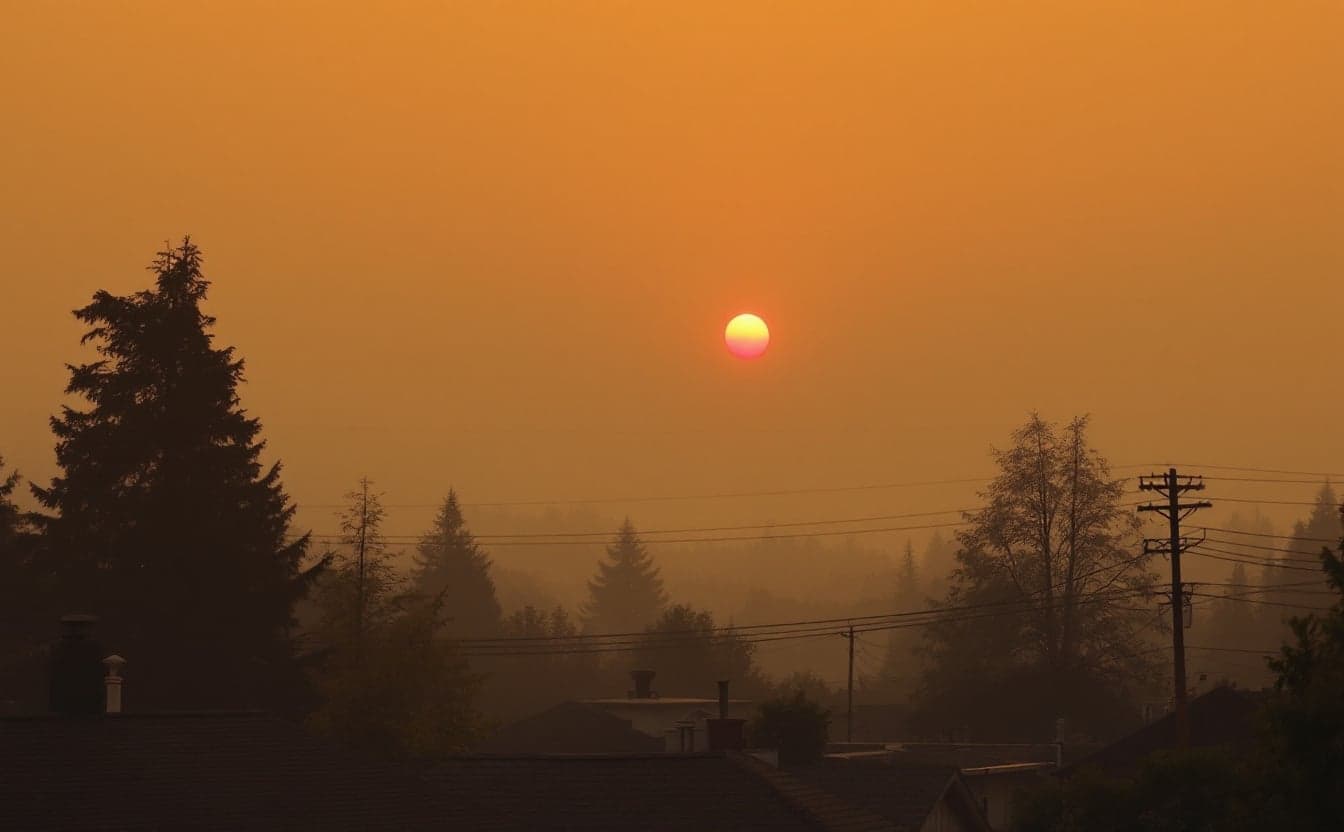
One more point: an orange sky is not a reading. Smoke can travel thousands of feet up, coloring the sunset while the air at street level stays moderate. The reverse happens too.
Three timelines from recent smoke seasons
In September 2020, after the Labor Day fires in Oregon, smoke settled over the western half of the state for more than a week. Portland, Eugene, Bend, Medford and Klamath Falls all logged their worst air quality on record; Portland's index reached the high 400s, about three times its previous record. Relief came when the weather turned and rain arrived later in the month.
In June 2023, smoke from fires in Quebec drifted south, and on June 7 New York City's air quality index rose above 300, into the hazardous range. The worst passed within days. But the same Canadian fire season kept burning, and smoke returned to parts of the Midwest and Northeast in waves through the rest of the summer.
The third timeline repeats every fire season in Western valleys: bad at dawn, better by mid-afternoon, bad again at night, day after day, for as long as fires burn upwind.
A note on comparing numbers. In May 2024 the EPA revised the fine-particle breakpoints of the Air Quality Index, and the same amount of smoke now shows a higher index value in the upper categories than it did in 2020 or 2023. Hazardous now begins at a lower concentration.
Reading the forecast and the map
The most useful single tool is the AirNow Fire and Smoke Map, run by the EPA and the US Forest Service. It pulls together readings from permanent monitors, temporary monitors set up for smoke events and low-cost sensors (with a correction applied), along with active fire locations and the smoke plumes seen by satellite. The plumes show smoke anywhere in the air column, so check the colored dots for what is happening at ground level.
The index values on AirNow use the NowCast, the EPA's way of handling fast-changing air. It averages the past 12 hours but gives more weight to recent hours when conditions are shifting, so it catches a smoke surge sooner than a 24-hour average would. When smoke is rolling in, the hourly reading may run ahead of the NowCast. Watch the trend over a few hours rather than a single number.
If you have a home monitor or a nearby sensor that shows fine particles (PM2.5) in micrograms per cubic meter, our AQI calculator converts the reading into an index value and a plain description of what it means for your day. It uses the EPA's current breakpoints, which are built for 24-hour averages, so treat a single reading as a rough guide.
For the days ahead, NOAA's smoke forecast model, state smoke blogs and apps in several Western states, and your local Weather Service office give outlooks. They are better at the next 24 to 48 hours than the next week.
Who feels it first
The fine particles in smoke are small enough to reach deep into the lungs and enter the bloodstream. They can cause coughing, stinging eyes and headaches in anyone. They can trigger asthma attacks, worsen COPD and set off heart problems in people who already have them.
The groups at highest risk are people with lung or heart disease, older adults, children (who breathe more air for their body size and spend more time outside), pregnant people and outdoor workers. So are people experiencing homelessness and anyone living in a drafty building without air conditioning, where closing windows in summer heat is not a real option. Before smoke season, refill rescue inhalers and go over your asthma action plan. Call 911 for chest pain, severe shortness of breath or confusion.
Turning one room into a clean room
You don't have to clean the whole house. The EPA's clean room guidance comes down to a few steps:
- Choose a room big enough for the household, ideally a bedroom.
- Close its windows and doors, without blocking your way out.
- Keep it cool with a fan or air conditioner, set to recirculate rather than draw in outside air.
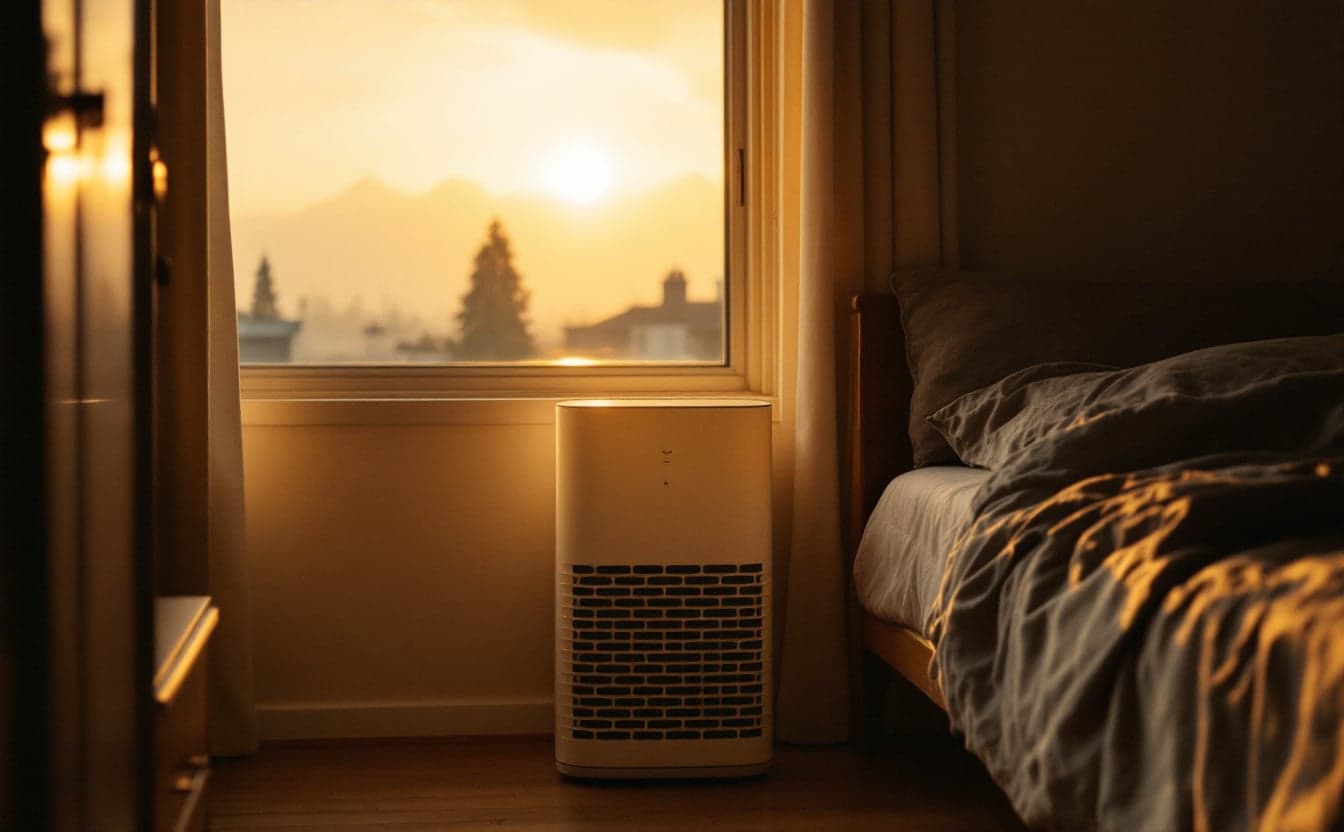
- Run an air cleaner sized for the room.
- Skip anything that adds smoke or particles: candles, frying, gas burners, aerosol sprays, smoking and vacuuming without a HEPA filter.
For a portable HEPA purifier, a common rule of thumb is a smoke clean air delivery rate (CADR) of at least two-thirds of the room's floor area in square feet. A 150-square-foot bedroom calls for a smoke CADR of at least 100.
The do-it-yourself version is a 20-inch box fan with a MERV 13 furnace filter strapped to the back, arrow pointing toward the fan. EPA researchers measured these and found that one filter helps, a cardboard shroud around the fan improves cleaning by about 40 percent, and a cube of four filters with the fan on top cleans several times more air. Their safety rules: use a fan made in 2012 or later with a UL or ETL mark, skip extension cords, don't leave children alone with it running, keep smoke alarms working, and replace the filter when it looks dirty or smells of smoke.
If your home has central heating or cooling, use a MERV 13 filter, or the highest MERV number your system can handle, set the fan to run continuously, close any outdoor air intake and change filters more often during smoke.
An indoor air monitor earns its place: compare its reading with the outdoor numbers, and you know whether your clean room is keeping up.
If closing up the house would make it dangerously hot, heat comes first. Go somewhere cooler for part of the day.
N95s: the fit is the filter
Cloth and surgical masks let most fine smoke particles through. A NIOSH-approved N95 respirator filters them, but only if air goes through the mask and not around it. Choose one with two head straps rather than ear loops, mold the metal strip over your nose, then exhale sharply and feel for leaks at the edges. Facial hair breaks the seal. Most N95s are sized for adults and won't fit young children. People with heart or lung disease should ask a clinician first, because breathing through a respirator takes more effort.
A pack of folding N95s lasts a household through a smoke week. Replace a mask when it is damp, dirty, damaged or harder to breathe through.
Outdoor workers: what the rules say
Farmworkers, roofers, delivery drivers and landscapers breathe smoke for whole shifts. A few states have permanent rules.
California's rule applies when the current AQI for fine particles reaches 151. Employers must tell workers the current AQI and how they are protected, train them, reduce exposure where feasible with filtered buildings or vehicles or by moving or rescheduling work, and provide N95s for voluntary use. At the most extreme smoke levels, respirator use becomes mandatory. Exposures of an hour or less per shift are exempt.
Oregon's rule starts earlier, at an AQI of 101 for fine particles (35.5 micrograms per cubic meter). Employers must monitor the air, train workers, set up two-way communication, use controls and offer N95s; at much higher concentrations, respirators become required. Oregon OSHA's fact sheet lists the trigger points in both the old and current index values, because the 2024 change shifted the numbers but not the concentrations. Washington's permanent rule took effect in January 2024.
Elsewhere, there is no federal wildfire smoke standard, so protection depends on the employer. Ask for N95s and breaks indoors, and put the request in writing.
Clean air centers and other help
Some cities and counties open clean air centers during heavy smoke, often in libraries and community centers with strong filtration, sometimes combined with cooling centers. Check your local health department or call 211. Some health departments and community groups hand out free N95s, and some programs provide air cleaners to people at high risk.
Smoke lands on top of everything else in the air. Neighborhoods next to highways, ports and industrial sites start smoke season with a heavier daily load. Our guide to reading an air permit explains how residents can weigh in on those permanent sources.
When the air clears
Open the windows once the outdoor reading drops below the indoor one, and let the house air out. Check the purifier and furnace filters; a gray filter after a smoke week has done its job. Wipe ash from sills and outdoor furniture with a damp cloth instead of sweeping it into the air. Then restock: a few N95s and a spare MERV 13 filter belong in your home emergency kit, ready for the next plume.
Next: try the AQI Calculator or browse the full Pack list.