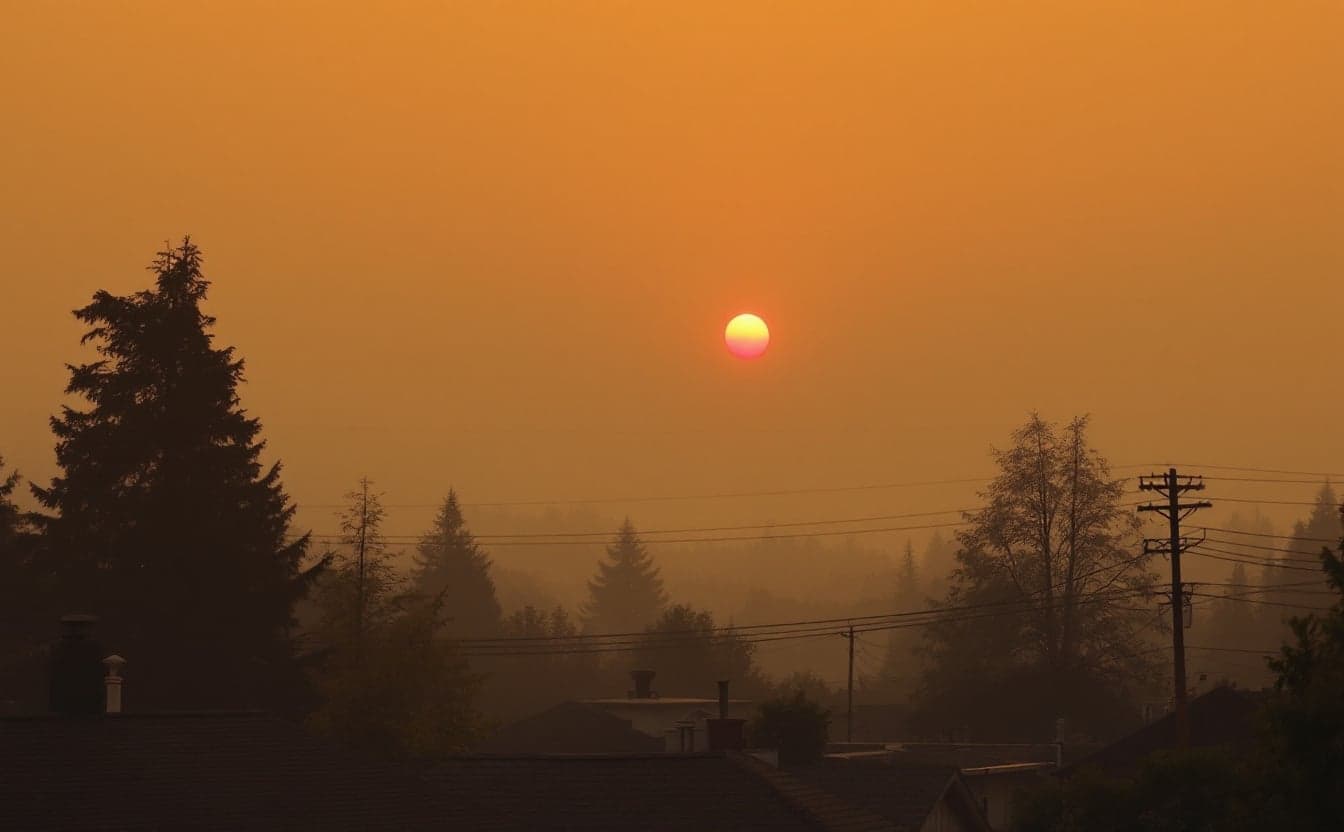



Best Air Purifier for Wildfire Smoke: How to Size It, What to Skip
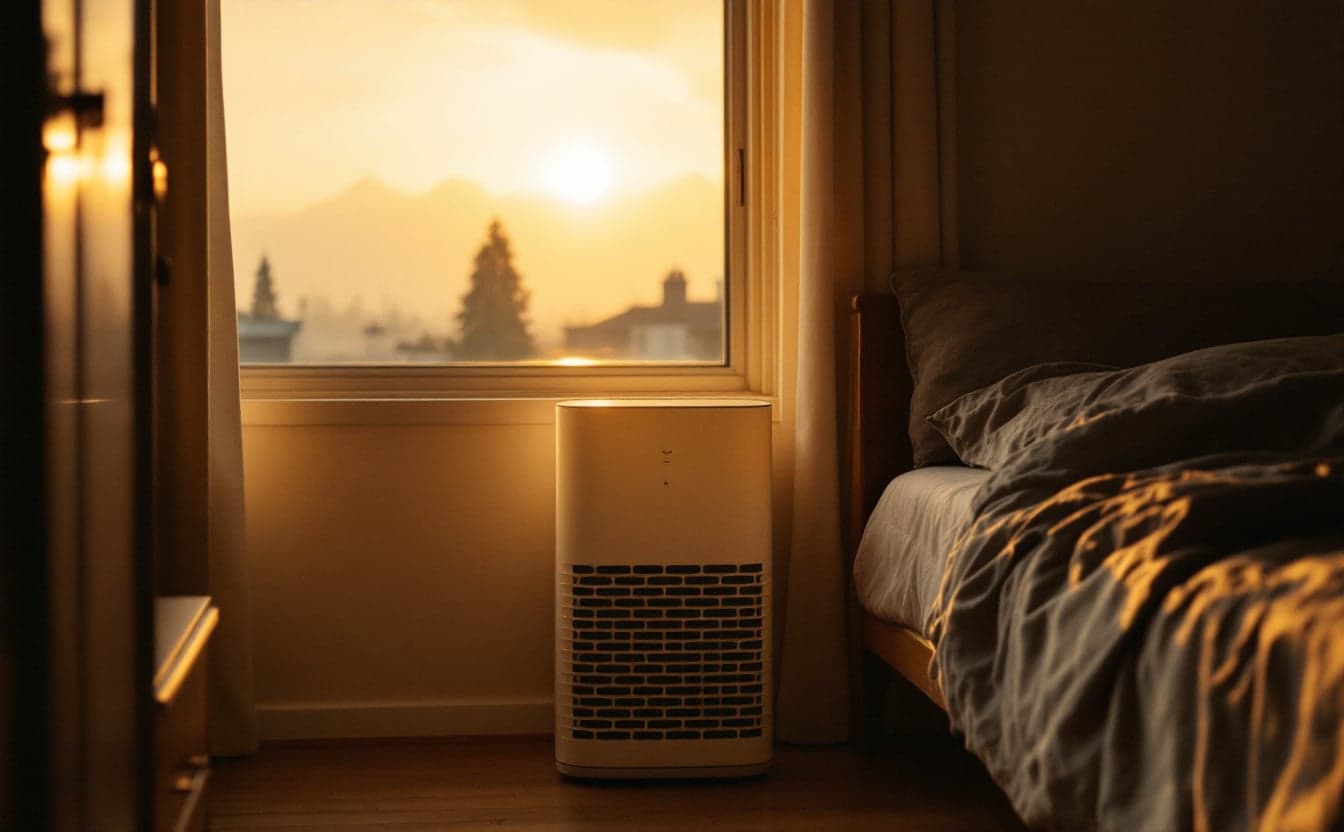
The best air purifier for wildfire smoke is a plain one: a true HEPA filter, a fan strong enough for the room you will shelter in, and no ozone. Size it by the smoke CADR printed on the box, not the square footage in the ad, and buy a spare filter the same day.
For most households that means one good unit in the bedroom, run on high while the smoke is heavy. Our first choice is the Coway Airmega AP-1512HH for bedrooms and medium rooms. The Levoit Core 300 costs less and suits a smaller bedroom, and the Levoit Core 400S covers a living room or an open plan.
Quick picks for smoke season
- Bedrooms and medium rooms: the Coway Airmega AP-1512HH, a HEPA unit with a carbon layer and an automatic mode.
- A smaller bedroom, at a lower cost: the Levoit Core 300.
- Living rooms and open floor plans: the Levoit Core 400S.
- Larger rooms where smoke odor hangs around: the Winix 5510, which adds a carbon layer aimed at smells.
We chose these from makers' specifications, published reviews and what owners report after a smoke season or two. We did not run trials of our own. Every pick uses a true HEPA filter, and none needs an ionizer to work.
Sizing by room: what CADR tells you
CADR stands for clean air delivery rate: how many cubic feet of filtered air a purifier puts out each minute. Most boxes list three numbers, for smoke, dust and pollen. Read the smoke number. Smoke particles are the smallest of the three, so that number matches your problem. A purifier with the AHAM Verifide mark has had its CADR claims checked by an independent lab.
The usual rule of thumb comes from AHAM, the appliance makers' association that runs the program: a smoke CADR of at least two-thirds of the room's floor area in square feet. For wildfire smoke, AHAM's own buying tips go further and recommend a smoke CADR equal to the room's area. The EPA's sizing chart lands close to the two-thirds line, and like AHAM's math, it assumes an 8-foot ceiling.
Here is how that works out.
| Room | Floor area | Smoke CADR, two-thirds rule | Smoke CADR, AHAM's smoke advice |
|---|---|---|---|
| Small bedroom, 10 by 11 ft | 110 sq ft | at least 73 | about 110 |
| Larger bedroom, 12 by 14 ft | 168 sq ft | at least 112 | about 168 |
| Living room, 15 by 20 ft | 300 sq ft | at least 200 | about 300 |
Size up for ceilings above 8 feet, a room that opens onto a kitchen or stairway, or a drafty older building. In an open plan, two smaller units in the rooms people use most can beat one large unit.
Watch for the room-size claims in product listings. Coway's own page lists the AP-1512HH for 361 square feet at 4.8 air changes an hour and for 1,748 square feet at one air change an hour. Same machine, same fan. For smoke, the smaller figure is the honest one.
True HEPA, and what to leave on the shelf
The EPA's definition of a HEPA filter: it can remove at least 99.97 percent of particles 0.3 microns across, the size that is hardest to catch, and does even better on larger and smaller ones. Words like "HEPA-type," "HEPA-style" or "HEPA-like" are marketing, not that standard. Look for "true HEPA" together with a published smoke CADR.
Carbon is a separate job. An activated carbon layer soaks up some odors and gases, which helps with the smell that lingers after a smoke event. It does not catch particles, and a thin carbon sheet fills up quickly.
Skip ozone generators entirely. The EPA's page on ozone generators is blunt: ozone can harm health, at levels that meet public health standards it does little to clean indoor air, and no federal agency has approved these machines for occupied spaces. Ozone also reacts with chemicals already in the room to form new irritants. For anyone with asthma, a machine that adds ozone works against itself.
Ionizers deserve caution too. The EPA lists ionizers, electrostatic precipitators and plasma units among the technologies that can give off ozone, and it found ionizers less effective at removing particles than high-efficiency filters. California has gone furthest: since 2010, every indoor air cleaner sold in or shipped to the state must give off less than 0.050 parts per million of ozone and carry an "ARB Certified" label. The state's list of certified devices is worth searching wherever you live. The same fact sheet warns about sellers calling ozone "activated oxygen."
If a purifier you like has an ionizer switch, leave it off. Two of our picks have one, and the HEPA filter does the particle work without it.
The picks, compared
| Pick | Best for | Filter type | What to know |
|---|---|---|---|
| Coway Airmega AP-1512HH | Bedrooms and medium rooms | Washable pre-filter, carbon, HEPA | Has an ionizer button; leave it off |
| Levoit Core 300 | Smaller bedrooms, dorm rooms, studios | Pre-filter, HEPA and carbon in one cylinder | Light enough to carry room to room; too small for a living room |
| Levoit Core 400S | Living rooms, open plans | Pre-filter, HEPA and carbon in one cylinder | The bigger Levoit, with app control |
| Winix 5510 | Larger rooms, lingering smoke odor | Pre-filter, carbon, HEPA | PlasmaWave has its own button; switch it off |
| Box fan with a MERV 13 filter | A stopgap or a second room | Furnace filter strapped to a fan | Do it yourself; follow the EPA's safety rules |
Coway Airmega AP-1512HH: the steady all-rounder
The Coway AP-1512HH has been sold for years, so replacement filters are easy to find. Air passes through a washable pre-filter, a carbon deodorization filter and a HEPA filter. In auto mode, a sensor adjusts the fan to the particle level, and a colored light shows how the room is doing.
Coway lists its smoke CADR at 233. By AHAM's stricter smoke advice, that covers a room of about 230 square feet, a big bedroom. By the two-thirds rule, about 350. Coway puts the HEPA filter at about a year and the carbon filter at about six months under normal use. A heavy smoke season shortens both. The unit has a separate ionizer button. Leave it off.
Levoit Core 300: a smaller bedroom for less
The Levoit Core 300 is the one to choose when the clean room is a modest bedroom, a dorm room or a studio. It is small and light, so you can run it in the living room by day and carry it to the bedroom at night. Its filter is a single cylinder with the pre-filter, HEPA and carbon layers together. Levoit says its standard models produce no ozone and no ions, so there is nothing to switch off.
Its limit is size. Check the smoke CADR on the box against the room table above before you buy it for anything bigger than a bedroom.
Levoit Core 400S: when everyone is in the living room
On smoke days many households end up together in one big room, with the TV on and the kids on the floor. The Levoit Core 400S is the larger Levoit for that room: true HEPA, a higher airflow than the Core 300, and an app for checking it from the next room. In an open plan, set it near where people sit, not in a far corner.
Winix 5510: larger rooms and the smell that stays
The Winix 5510 pairs its HEPA filter with a carbon layer that helps with smoke odor, and it is sized for larger rooms. It is a good fit for a house that smells of smoke for days after the air outside clears. Winix's PlasmaWave feature works on the ionizer principle and has its own button. Switch it off; the filters keep working.
One clean room, run on high
You do not need to clean the whole house. Pick the room where the household sleeps, since that is a third of every day, close the door, and let the purifier work on a space it can actually keep up with.
A few placement details make a difference. Set the purifier in the open, a couple of feet from walls and furniture, so air can reach the intake. The EPA's wildfire and indoor air guidance says to run it as often as possible on the highest fan speed during smoke events. If high is too loud for sleep, run it on high with the door shut through the evening and drop one step at bedtime.
To know whether the room is keeping up, measure it. A PM2.5 monitor shows the indoor fine-particle level, and our AQI calculator turns that reading into an index value you can compare with the outdoor forecast. If the indoor number keeps climbing, close gaps, add a second cleaner or move to a smaller room.
Closing up a house in late summer can make it dangerously hot, and then heat becomes the bigger risk. Our guide to heat stroke and heat exhaustion covers the warning signs and where to find a cooling center.
Filters during smoke season
A smoke week can do months of ordinary wear to a filter. The EPA advises keeping extra filters on hand and planning to replace them more often than the maker recommends during heavy smoke, and sooner if they look heavily soiled. A gray HEPA filter after one bad week is normal.
Many filter-change lights run on a timer, so they cannot tell a smoky week from a clean one. Pull the filter and look.
Buy the spare when you buy the purifier. Once the sky turns orange, local shelves empty fast. Stick to the maker's replacement filter or one that clearly states it fits your model; a filter that sits loose lets air slip around it. Change it outdoors or over an open trash bag, and wash your hands afterward. Vacuum or rinse the washable pre-filter, if your model has one, every couple of weeks during smoke.
If the home has central air or a forced-air furnace, its filter counts too. A MERV 13 furnace filter, or the highest MERV number your system can handle, catches far more smoke than the thin filters many systems come with. Set the system fan to run continuously and close any outdoor air intake.
What it costs to run
There are two running costs: electricity and filters.
For electricity, find the watts on the label or in the manual. Multiply by the hours it runs and divide by 1,000 to get kilowatt-hours, then multiply by the rate printed on your utility bill. A 50-watt unit running on high around the clock uses 1.2 kilowatt-hours a day, or about 17 over a two-week smoke event. On a lower setting it uses much less. Purifiers with the Energy Star label are certified on how much clean air they deliver per watt, so they do the same job on less power.
Filters usually cost more than the electricity over a year, especially in a bad smoke season that calls for two or three changes. Before you choose a model, look up what its replacement filters cost and whether stores near you carry them.
Help exists, unevenly. Some health departments, air districts and community groups hand out air cleaners to people at high risk before or during smoke season. Some state Medicaid programs have covered them too: Oregon's, for one, has paid for air filtration devices for some members whose health conditions are worsened by poor air quality. Ask your health plan, your local health department or 211. Libraries and community centers that open as clean air centers are free.
Renters and drafty buildings
A portable purifier needs no installation and no landlord's permission, and it moves with you.
The building still matters. Older, drafty homes let more outdoor smoke inside, and their tenants are often the least able to fix that themselves. A few things to ask a landlord for, in writing:
- Fresh HVAC filters before smoke season, MERV 13 if the system can handle it.
- Weatherstripping on leaky windows and a sweep on the outside door.
- Whether the building's ventilation can be set to recirculate during smoke.
Many weatherization programs serve renters when the landlord agrees, and our explainer on weatherization help covers how to ask. Air sealing that keeps winter drafts out also keeps smoke out. Until then, a rolled towel along the bottom of a drafty door helps through a smoke week.
The box-fan filter, when a purifier is out of reach
If a purifier is out of reach this year, or you need a second clean room, the do-it-yourself version works. Strap a 20-inch box fan to a 20 by 20 inch MERV 13 furnace filter, with the filter's airflow arrow pointing toward the fan. The EPA still prefers a commercial unit with a known CADR when you can get one, and its safety rules for the fan matter: a fan made in 2012 or later with a UL or ETL mark, no extension cords, and no running it unattended around children. Our guide to how long wildfire smoke lasts has the full setup, along with the EPA's clean room steps.
Whichever route you take, do the measuring before the next smoke season. Write the clean room's floor area on the inside of a closet door, buy the purifier and a spare filter in spring while shelves are full, and run the unit for a night so you know how loud each setting is before you need it.
Next: try the AQI Calculator or browse the full Pack list.